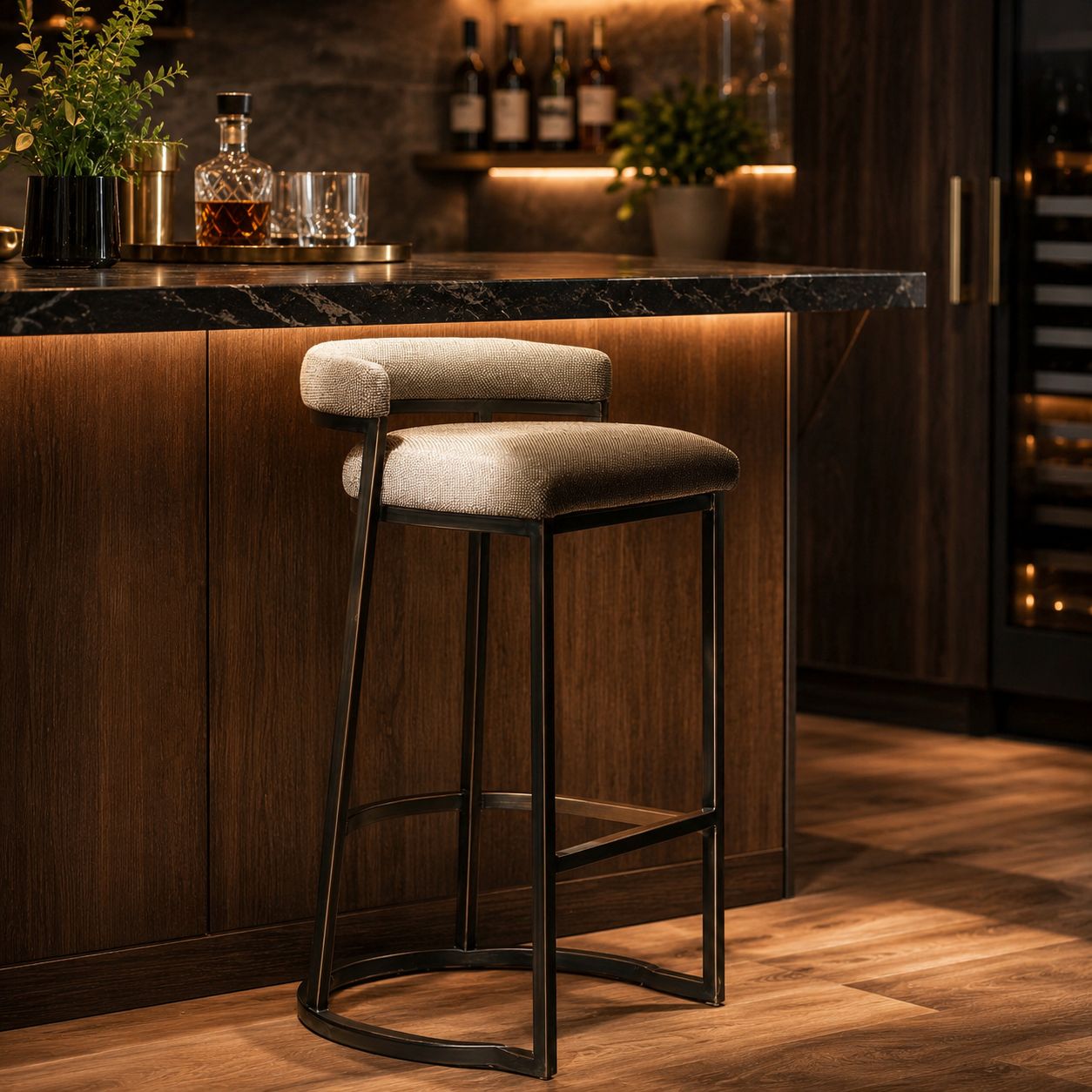
You've designed the kitchen, picked the worktop, chosen the appliances. Then the question: what stools go at the island? The wrong height is the most common interior mistake we see — and the most expensive to fix later. Here's the only test that matters.
Measure your worktop.
Get a tape measure to the top surface of your island or counter. There's only one number that matters: height from the floor.
- 85–95 cm → you need counter height stools (seat height around 65 cm).
- 105–115 cm → you need bar height stools (seat height around 76 cm).
The rule of thumb: leave 25–30 cm between the top of the seat and the underside of the worktop. Less than 25 cm and people's knees hit. More than 30 cm and short guests feel like they're perched.
What does that mean in practice?
Most UAE kitchen islands in Dubai Hills, Arabian Ranches, and the newer Saadiyat villas are built at 90 cm — the same height as a kitchen counter. That's counter height.
Older homes and apartments where the island was retrofitted higher — common in the renovated Jumeirah houses and the larger Palm Jumeirah villas — often have islands at 105–110 cm. That's bar height.
If you're unsure, our Hakone Barstool, like every Nader bar stool, comes in both heights. The same silhouette in either seat height.
How many stools, really?
Allow 60 cm per stool. A 180 cm island can comfortably seat three; squeeze in four and elbows touch. A 240 cm island handles four comfortably. Anything wider, plan for the conversation distance — sometimes three well-spaced stools beat four cramped ones.
Back, no back, or low back?
Backless stools tuck fully under the island when not in use — neat in apartment kitchens. Low-back stools (like the Hakone or the Kurume Barstool) are the most-popular compromise: enough back support to sit through dinner, slim enough to slip under. Tall-back stools (like the Himeji Barstool) work when the stools are part of the room's design — visible from the living area, statement-making.
Fabric versus leather at an island.
Fabric stools look softer. Leather wipes cleaner. If you cook often and the island is where things get plated, leather earns its place — full-grain or textured. If the island is decorative and you mostly use the dining table, fabric gives the kitchen a softer reading.
Three things people forget.
- Swivel or fixed? Swivel stools make conversation easier across the island. Fixed look cleaner from the side.
- Footrest. Counter and bar stools need an integrated footrest. Without it, your feet dangle and the stool gets uncomfortable in twenty minutes.
- Floor protectors. Stone, tile, and parquet all need stool-foot pads. We supply them with every order.
See all 18 bar stool silhouettes.
Each one is made in your choice of counter or bar seat height, 1,000+ fabric and leather options. Browse the full lineup.
View bar stools →