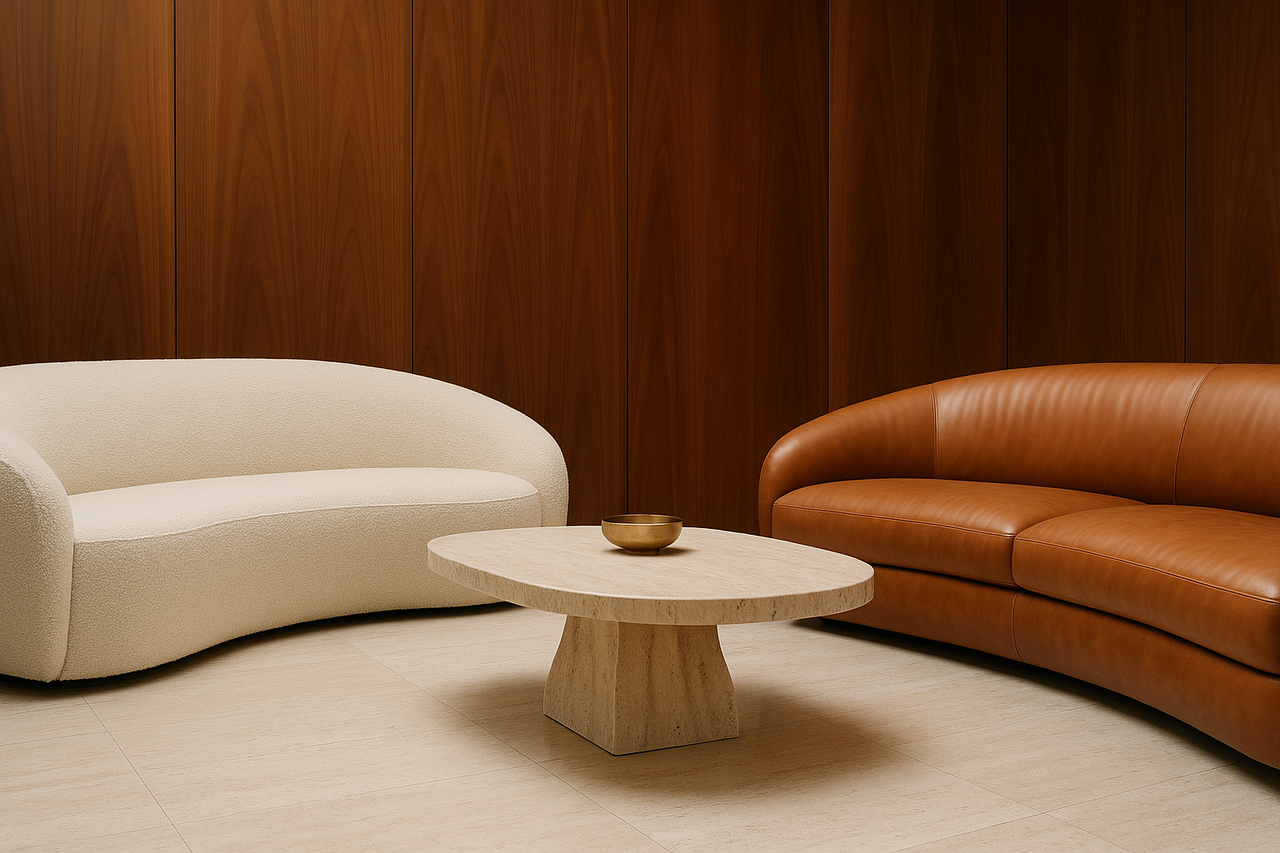
Of every question we get on the showroom floor, "should I get leather or fabric?" is the one most distorted by hearsay. There's no universal answer — the right choice depends on your room, your air conditioning, your family, and how you actually sit. Here's the unvarnished version we'd give a friend.
The first myth: leather is hot in the UAE.
This is half-true. Bare-skin contact with leather in a 26 °C-AC room feels slightly cool, not hot — the surface is at room temperature. Leather feels hot only when it's been in direct sun (which any fabric will too) or when you sit on it in shorts after the AC has been off for hours. In any normally-cooled home — which is essentially every home in Dubai Marina, Dubai Hills, or Saadiyat — leather behaves fine.
The second myth: leather doesn't stain.
Also half-true. Leather doesn't absorb water-based spills, but it absorbs oil-based ones rapidly — sunscreen, hair products, salad dressing, lotion. A water-based spill is wiped clean in seconds. An oily mark is permanent unless you act fast. Fabric, conversely, absorbs everything but releases water-based spills with care. They're complementary failure modes.
Where leather wins.
- Daily-use family rooms with no pets. Wipe-clean is unbeatable for everyday use if you control for oily spills.
- High-design statement spaces. A leather sofa in a modernist Palm Jumeirah living room reads serious in a way fabric can't match.
- Hospitality interiors. Cafés, restaurants, lobbies — leather absorbs less smell and cleans visually.
- Long-term value. Full-grain leather ages, develops patina, and looks better at year five than year one.
Where fabric wins.
- Households with cats. Leather and claws is a one-sided fight that leather loses.
- Tactile-comfort rooms. Bouclé, velvet, and chenille feel softer to skin contact than even premium leather.
- Compact rooms. Soft fabric reads warmer in tight spaces; leather can feel cold.
- Colour flexibility. 1,000+ fabric options vs ~30 leathers.
Plain vs textured leather.
Plain leather (smooth, full-grain) shows every scratch and scuff in the first six months — they become character. Textured leather (pebbled, embossed) hides everything. For families, choose textured. For statement-design lovers, plain. The Kobe Corner Sofa in textured leather is one of our most-resilient configurations.
Climate-specific notes.
- Coastal areas (Palm Jumeirah, JBR, Jumeirah): humid air means leather needs conditioning once a year. Fabric stays comfortable.
- Inland UAE (Al Ain, Mirdif): drier climate. Leather conditioning becomes critical to prevent cracking — twice a year is wise.
- High-rises with strong AC (most apartments): both materials behave well. Choose by lifestyle, not climate.
Cost over ten years.
Day-one cost: leather sofas cost roughly 30–50% more than the same silhouette in fabric.
Ten-year cost: usually closer. Fabric needs more frequent professional cleaning; cushion covers may need replacing once. Leather needs conditioning once or twice a year and resists most damage. Both can be refurbished — but neither is a "buy once and forget" decision.
The decision tree.
Cats? Fabric.
Kids under five plus oily-spill anxiety? Textured leather or stain-treated chenille.
Hospitality use? Leather.
You want it to feel soft to touch? Fabric.
You want a statement-design centrepiece? Either — depends on the room.
See both side by side.
Visit our Sharjah showroom and sit on the same silhouette in leather and in fabric. The decision usually makes itself in five minutes.
Find the showroom →